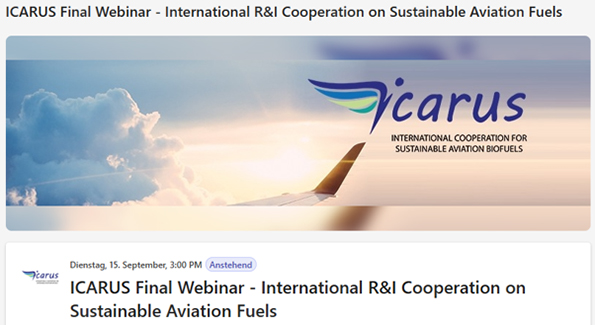
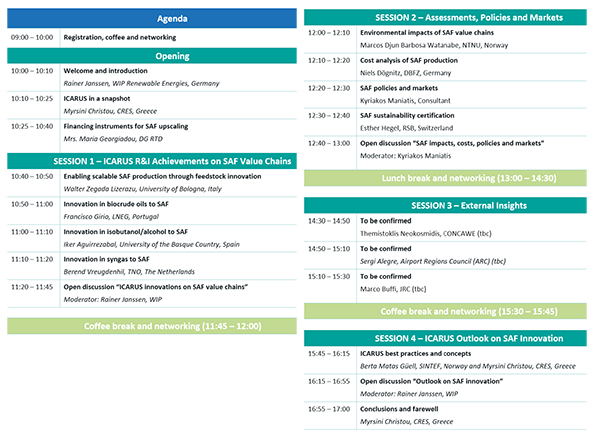
 ICARUS Final Webinar - International R&I Cooperation on Sustainable Aviation Fuels, 15 September 2026 15 September 2026 (15:00 – 17:00 CET)
This Final ICARUS Webinar serves to present and discuss project results
with members of the External Executive Advisory Board (EEAB), the end
users (EU) and other interested stakeholders active in the field of
Sustainable Aviation Fuels (SAF).
ICARUS R&I results address innovative solutions and concepts for
up-scaling for three main SAF production routes, namely Biocrude from
hydrothermal liquefaction to SAF, Isobutanol from lignocellulosic
biomass to SAF, and Synthetic Fischer-Tropsch from biomass gasification
to SAF. Furthermore, ICARUS outcomes concern increased sustainable
biomass supply, techno-economic, environmental, and social assessments
throughout the entire value chains, as well as SAF certification,
policies and markets.
ICARUS has strong participation from Mission Innovation countries
facilitating market deployment of SAF based on the value chains
mentioned above in the EU and beyond.
We look forward to meeting you at the ICARUS Final Webinar.
|
ICARUS Final Conference, 25 September 2026, Brussels - Registration Open25 September 2026, Comet Louise, Pl. Stephanie 20 in Brussels
This ICARUS Final Conference serves to present and discuss project
results with interested stakeholders active in the field of Sustainable
Aviation Fuels (SAF) at an on-site event in Brussels.
The ICARUS project provides innovative solutions and concepts for up-scaling for three main SAF production routes, namely Biocrude from hydrothermal liquefaction to SAF, Isobutanol from lignocellulosic biomass to SAF, and Synthetic Fischer-Tropsch from biomass gasification to SAF.
Project targets include increased and sustainable biomass supply,
cutting edge technological developments, techno-economic, environmental,
and social assessments throughout the entire value chains.
Conference Registration:
Please, send an email confirming your participation to rainer.janssen@wip-munich.de
 |
Save the Date - 2nd Conference on SAF: Time for Take-off12–13 November 2026, Athens, Greece
Partners from the ICARUS project are actively contribution to the 2nd
Conference on Sustainable Aviation Fuels (SAF): “Time for Take-off”
organized by the ICARUS coordinator Centre for Renewable Energy Sources
and Saving (CRES)
|  |
Building on the success of the inaugural conference held in 2024,
this event will focus on the challenges and opportunities arising from
the implementation of the EU ReFuelEU Aviation Initiative, with
particular emphasis on the development and deployment of eSAF (synthetic
aviation fuels).
The event is addressed to decision-makers, industry representatives,
investors, researchers, and experts involved in SAF and eSAF production
and deployment. Further information will be available soon.
|
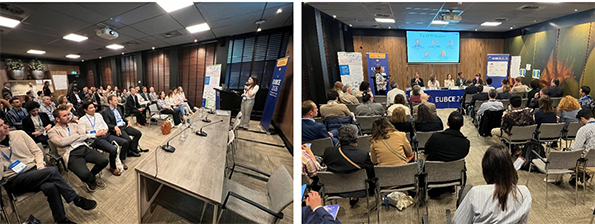
ICARUS at EUBCE 2026: Co-creation Workshop on Best Practices and ConceptsOn 21 May 2026, ICARUS organised an on-site co-creation workshop entitled SAF Upscaling – Time for Action!
at the 34th European Biomass Conference & Exhibition (EUBCE) in The
Hague. It had been concluded that organising a single umbrella workshop
would be the most impactful approach.
The event brought together more than 60 participants from around the
world – including Europe, Brazil, the United States, Thailand, and other
regions – resulting in a fully packed room that clearly reflected the
strong interest in, and high relevance of SAF upscaling.
The workshop was structured around three main blocks. The first block,
fully represented by ICARUS partners (SINTEF, CRES, University of the
Basque Country, TNO, NTNU & DBFZ), focused on the technology
dimension, starting with how innovative feedstock strategies can unlock
large-scale SAF deployment and reduce reliance on limited resources. It
presented then the latest conversion technology developments to overcome
process limitations and accelerate commercialization, concluding with
an analysis of production costs and environmental impacts for the
selected pathways.
The second block
moved beyond technology to address policy frameworks, market dynamics,
and sustainability certification requirements, including financing needs
and instruments essential for SAF upscaling. This session engaged both
project partners (KM-IIC and RSB) as well as Maria Georgiadou, senior
expert on renewable fuels, biofuels and bioenergy in the European
Commission (DG-RTD).
Finally, the third block
featured a panel discussion and interactive co-creation session,
designed to gather diverse perspectives and integrate them into the
ongoing ICARUS work on best-practices and concepts for SAF upscaling.
The panel consisted of senior representatives from both industry,
academia and the European Commission.
Results from the Co-creation workshop will be available soon at the ICARUS website.
|
Overview of ICARUS Key Exploitable Results (KERs)Commercial
exploitation of European technologies for uptake on global markets is
considered throughout the ICARUS project to maximize the impact and
market penetration of research results. Potentially valuable
intellectual property (IP) is captured, evaluated and protected by
appropriate means. These actions are described in the “Plan for
dissemination and exploitation including communication activities” that
is updated throughout the project.
A specific Exploitation Outlook Summary (EOS) Report
will highlight opportunities and provide guidelines to exploit for the
exploitation of project results beyond the project duration.
The following five ICARUS Key Exploitable Results (KERs) have been identified.
KER 1: New knowledge on mixed cropping systems - Practical agronomic guidelines
Description: This KER offers new knowledge on how growing two crops together (intercropping)
– such as sorghum with a legume – can improve lignocellulosic feedstock
yield per unit of land area, reduce the need of fertilizers, and make
farming systems more resilient. The results come from field trials and
provide practical advice for farmers interested in sustainable feedstock
crop production.
Key end users: Biomass-producing farmers
KER 2: Nitrogen removal technology for improving the quality of biocrude oils
Description: The developed nitrogen (N) removal technology based on microalgae pre-treatment
is a process solution integrated into biocrude upgrading. Due to the
complexity and heterogeneity of feedstocks, physical and chemical
pretreatments methods are essential to reduce nitrogen content and
improve feedstock quality prior hydrotreatment (e.g.,
hydrodeoxygenation, HDO).
Key end users: Customers/end-users: Catalyst and enzyme companies, chemical industry, aviation sector
KER 3: Optimized yeast for the direct conversion of cellulose and C5 and C6 sugars into isobutanol
Description: This KER is an industrial yeast strain that produces isobutanol
instead of ethanol and secretes all major cellulolytic enzymes. It will
allow to drastically reduce the requirement for commercial cellulase
enzyme cocktails in the saccharification process of the lignocellulosic
biomass.
Key end users: Chemical companies using isobutanol as solvent or chemical reagent, biofuel companies selling isobutanol
KER 4: Novel syngas-to-SAF production process (SOSAF)
Description:
This KER addresses an innovative technology for SAF production from
syngas, which has improved carbon selectivity (over 50 %C) compared to
current syngas-to-SAF benchmark technologies. The technology involves
three catalytic conversions using novel and conventional catalysts. It
involves in a first step the production of olefins from syngas directly,
followed by oligomerization and hydrogenation to SAF.
Key end users: General fuel producers or dedicated SAF producers
KER 5: Impact indicators for sustainability assessments of SAF production routes
Description: This
KER consists of the application of sustainability assessment methods to
evaluate different early-stage sustainable aviation fuel production
routes. It provides a set of environmental, economic, and social impact
indicators, together with supporting data and analysis. The result
enables technology developers to assess and improve their processes and
supports policymakers with evidence to guide decisions on the
development and deployment of sustainable aviation fuels.
Key end users: Fuel producers, technology providers, research organisations, policymakers
|
The EU-funded project ICARUS – International Cooperation for Sustainable Aviation Biofuels
– is dedicated to advancing Sustainable Aviation Fuel (SAF) production
by addressing critical technology limitations for three pivotal SAF
production routes: biocrude
from hydrothermal liquefaction to SAF, isobutanol from lignocellulosic
biomass to SAF, and synthetic Fischer-Tropsch fuels from biomass
gasification to SAF. These three value chains have been
strategically chosen due to their proximity to market and their
indispensable role in achieving European and international SAF
deployment targets.
ICARUS builds on a strong international consortium of 20 reputed
partners including 5 partners from three Mission Innovation Countries
(MIC) Canada, India and Brazil, and two partners from USA joining
R&I activities as members of the External Executive Advisory Board
(EEAB).
 | www.icarus-biojet.eu
This project has received funding from the European Union's Horizon 2020
research and innovation programme under Grant Agreement No 101122303. |
| |
Follow us on:
| For further information please contact:
Dissemination & Communication Contact
Rainer Janssen • rainer.janssen@wip-munich.de
Dominik Rutz • dominik.rutz@wip-munich.de
WIP Renewable Energies
Sylvensteinstr. 2, 81369 Munich, Germany
www.wip-munich.de |
| |
|