 ICARUS General Assembly in Bilbao,
18-19 March 2026 The
sixth General Assembly of the ICARUS project was hosted by the
University of the Basque Country (UPV/EHU) and took place in Bilbao on
18-19 March 2026. The meeting served to present and discuss recent
research progress for the three ICARUS value chains and agree on
upcoming cooperation activities. | 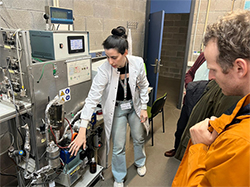 |
The
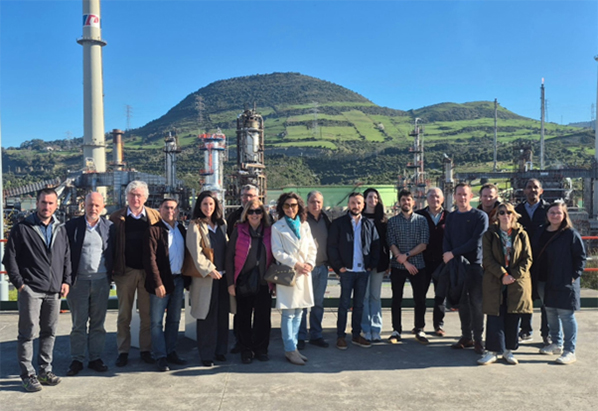
meeting included a technical visit to a refinery operated by PETRONOR
in the vicinity of Bilbao providing an overview of their current R&I
activities in the field of Sustainable Aviation Fuels and a visit to
Bureau Veritas at the Energy Intelligence Centre engaged in analysis and
certification of electrochemical processes and renewable hydrogen.
Furthermore, ICARUS partners had the opportunity to see the laboratories
at UPV/EHU where recent research on catalysts for the oligomerization
of isobutanol to C8-C12 olefins for the ICARUS AtJ pathway was presented
and discussed.
 |
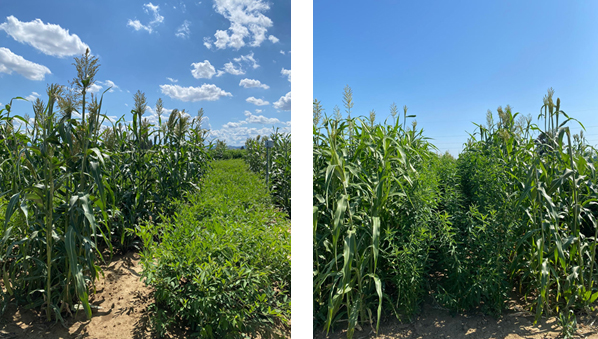
ICARUS Early Insights: Intercropping shows promise for SAF feedstockPreliminary
results from recent trials performed by ICARUS partner University of
Bologna (UNIBO) suggest that sorghum-based intercropping systems may
significantly enhance biomass production for sustainable aviation fuels
(SAF).
Encouragingly, the use of a PGPR (Polyglycerin-Polyricinoleat)-based
bio-stimulant appeared to further boost biomass yields under certain
conditions. Importantly, biomass quality remained consistent across
treatments, with key components for biofuel production, such as
cellulose and hemicellulose, showing no significant variation. These
early findings point to the potential of intercropping strategies to
strengthen SAF supply chains by increasing biomass availability without
compromising feedstock quality. Note: these results are highly
preliminary, based on a single growing season, and will require
validation through additional multi-year trials.
 |
ICARUS Results on Techno-Economics and Sustainability of SAF value chainsWithin
ICARUS, a comprehensive screening of quantitative and qualitative
indicators has been finalized, providing a clear overview of current
cost structures, greenhouse gas (GHG) emissions, and other environmental
impacts associated with the main SAF pathways investigated in
ICARUS.
In parallel, detailed analyses of bio-oil-, iso-butanol-, and
syngas-to-SAF value chains are underway, integrating ICARUS data into
comprehensive techno-economic, life cycle, and social impact assessment
frameworks to evaluate both current and projected sustainability
performance of low-TRL SAF production pathways. Additionally, an updated
and continuous review of global market developments, together with a
thorough analysis of international SAF policies and certification
frameworks, is being conducted to capture emerging trends and future
prospects for SAF supply and demand across the entire value chain.
The techno-economic assessment (TEA) framework established within the
project has enabled a comprehensive evaluation of the economic viability
of the ICARUS SAF production routes. The results from the TEA framework
have shown that the Biocrude-to-SAF and Alcohol-to-Jet pathways exhibit
relatively low production costs, making them more attractive options
for industrial-scale implementation. In contrast, the Syngas-based
Fischer-Tropsch fuels have higher production costs but offer advantages
in terms of energy density and flexibility in feedstock utilization. The
ICARUS project outcomes have identified key areas for future research
and development, including the improvement of conversion efficiencies,
the development of more sustainable feedstock options, and the
optimization of production processes. By addressing these challenges,
the ICARUS project aims to contribute to the development of a more
sustainable and resilient aviation sector, capable of meeting the
demands of a growing global population while minimizing its
environmental impacts. |
ICARUS Progress on Best Practices and ConceptsA
draft report on best practices and concepts for SAF upscaling is
currently being finalized. The report is built on four key pillars: (1)
publicly available information, (2) knowledge and data generated within
the project, (3) insights from extensive interviews with key
stakeholders and R&I experts, and (4) findings from a multi step co
creation process that includes by invitation-only webinars and an open
workshop scheduled for May 2026.
The analysis covers the three value chains addressed in ICARUS and
incorporates both technological elements and non-technological factors
such as policy and market considerations. These are examined across
three overarching dimensions: drivers, barriers, and innovation
potentials.
Key messages emerging from the findings to date include:
- Feedstock availability and flexibility are central bottlenecks, as well as enablers of SAF scale up
Preliminary results show that SAF upscaling is ultimately constrained
by access to sufficient, eligible, and affordable feedstock, rather than
by a lack of conversion pathways. At the same time, feedstock
flexibility is highlighted as a core best practice across all three
ICARUS value chains (HTL, alcohol to jet, syngas FT), as it enables cost
control, resilience against seasonal variation, and avoidance of
monopolistic supply situations.
- Technology is not the main limiter, commercialization - scale up risk and CAPEX are
None of the three advanced SAF pathways is limited primarily by
fundamental science. Instead, scale up is hindered by high CAPEX,
limited demonstration experience, and integration risks when moving from
pilot to commercial scale. Successful SAF deployment depends more on
de-risking scale up than on inventing new pathways.
- Policy certainty creates demand, but is insufficient to secure European SAF supply
Preliminary results indicate that ReFuelEU Aviation is a necessary but
not sufficient condition to deploy large scale SAF production using
European feedstock in Europe. While mandates clearly create demand and
market visibility, stakeholders consistently argue that they do not
automatically translate into domestic production capacity.
|
ICARUS Dedicated Webinars for the External Advisory BoardAt
the inception of ICARUS, an External Advisory Board (EAB) was
established as an important instrument to guide and advise ICARUS
partners on the project and research implementation. Furthermore, ICARUS
foresaw close coordination with the aviation sector via the Airport
Regions Council (ARC) and the oil sector via CONCAWE. During
implementation it was decided to merge the EAB with the representatives
from the aviation and oil sectors to have better coordination between
the external advisory bodies and the ICARUS team. The members of the
ICARUS EAB are:
- Mr Sergi Alegre, Director General, ARC
- Dr Robert Baldwin, Principal Scientist, National Laboratory of the Rockies (NLR), US,
- Prof Marisol Berti, North Dakota State University, (NDSU), US
- Ms Anne Bouter, EC, DG JRC
- Dr Marco Buffi, EC, DG JRC
- Prof Stephen Dooley, Trinity College Dublin, Ireland and EU SAF Clearing House
- Mr Tomas Ekbom, AFRY, Sweden, & IEA Bioenergy TCP, Task 39
- Mr Themistoklis Neokosmidis, CONCAWE
- Prof Glaucia Souza, Bioenergy Research Program Coordinator, University of São Paulo, Brazil (Note:
The EAB members can delegate other persons to replace them in case of
unavailability to attend a webinar or other meeting)
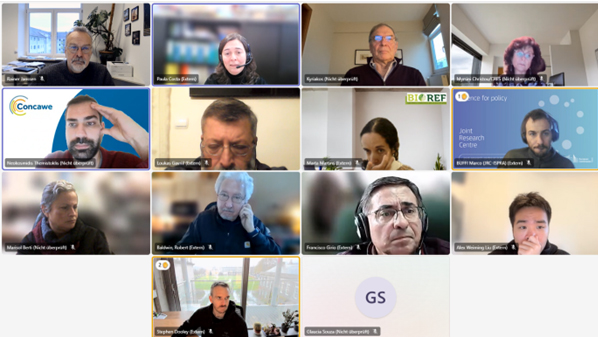
It
was decided that the most effective way for communications would be to
arrange dedicated webinars between ICARUS and the EAB members and
whenever possible to invite the EAB members to attend the project
meetings. In November and December 2025, three EAB webinars were
organised for each ICARUS value chain to discuss progress on the
research work:
- 28/11/2025, Isobutanol to SAF
- 05/12/2025, Crude to SAF
- 11/12/2028, Syngas to SAF
All
meetings were organised with an introduction to ICARUS, and then
presentation on the work carried out, challenges and progress achieved,
followed by a discussion and Q&A session. In 2026 the EAB webinars
will continue on the topics:
- Global SAF Policies, (organised on 26/03/2026)
- SAF Global Market Development (24/04/2026)
- SAF certification (29/05/2026)
Towards
the end of the project, the technology webinars given in 2025 will be
repeated presenting EAB with the final results of ICARUS.
|
ICARUS at EUBCE 2026: Co-creation Workshop on Best Practices and ConceptsAn
ICARUS Co-creation Workshop will be organised on 21 May 2026 in The
Hague on the occasion of the 34th European Biomass Conference and
Exhibition (EUBCE 2026). This workshop aims to support the development
of best practices and concepts across the entire value chain for three
technological pathways to accelerate the scale-up of SAF production
worldwide.
The workshop will be structured around three main blocks. The first
block will focus on the technological dimension, starting with how
innovative feedstock strategies can unlock large-scale SAF deployment
and reduce reliance on limited resources. It will then present the
latest conversion technology developments to overcome process
limitations and accelerate commercialization, including an analysis of
production costs and environmental impacts for the selected pathways.
The second block will move beyond technology to address policy
frameworks, market dynamics, and sustainability certification
requirements, including financing needs and instruments essential for
SAF upscaling.
Finally, the third block will feature a panel discussion and interactive
co-creation session, designed to gather diverse perspectives and
integrate them into the ongoing ICARUS work. This closing session offers
participants a unique opportunity to contribute directly to shaping
future best practices and supporting the expansion of SAF across Europe
and beyond.
For further information on the Co-creation workshop, please visit:
|
ICARUS Training: Contribution to Webinar on Teaching the Energy TransitionICARUS
was invited to contribute to a Training Webinar organized on 12 May
2026 in the framework of the European project NIAGARA ( https://niagaraproject.eu/) on Teaching the Energy Transition - Bringing circular bio-based energy innovations from EU projects into the classroom.
This webinar will explore how EU-funded research on circular bio-based
energy and advanced biofuels can be translated into education-ready
knowledge and integrated into technical education.
The session will feature presentations from the NIAGARA, ICARUS and
FUELGAE projects, members of the SUSTAFUELS Cluster, followed by a
roundtable discussion with project representatives and educators.
The ICARUS project looks forward to your participation. |
The EU-funded project ICARUS – International Cooperation for Sustainable Aviation Biofuels
– is dedicated to advancing Sustainable Aviation Fuel (SAF) production
by addressing critical technology limitations for three pivotal SAF
production routes: biocrude
from hydrothermal liquefaction to SAF, isobutanol from lignocellulosic
biomass to SAF, and synthetic Fischer-Tropsch fuels from biomass
gasification to SAF. These three value chains have been
strategically chosen due to their proximity to market and their
indispensable role in achieving European and international SAF
deployment targets.
ICARUS builds on a strong international consortium of 20 reputed
partners including 5 partners from three Mission Innovation Countries
(MIC) Canada, India and Brazil, and two partners from USA joining
R&I activities as members of the External Executive Advisory Board
(EEAB).
 | www.icarus-biojet.eu
This project has received funding from the European Union's Horizon 2020
research and innovation programme under Grant Agreement No 101122303. |
| |
Follow us on:
| For further information please contact:
Dissemination & Communication Contact
Rainer Janssen • rainer.janssen@wip-munich.de
Dominik Rutz • dominik.rutz@wip-munich.de
WIP Renewable Energies
Sylvensteinstr. 2, 81369 Munich, Germany
www.wip-munich.de |
| |
|